It’s kind of like a barn-raising. When you pour a concrete foundation here in the remote far-north, neighbors and relatives join in while the hostess provides drinks and food as a coordinated dance ensues: Pour. Spread. Level. Smooth. Repeat.
We hired a few experts, but it was the “show-up-if-you-can” group effort that made it work. They did show up. And it all took shape within a few days. Amazing! Heart-warming!
And, risky. “There’s only two guarantees when it comes to pouring concrete,” said one of the workers with lots of experience. “It will be fire-proof, and it will be theft-proof.” If you’re one of those people who likes guarantees and you’re paying for a concrete foundation, don’t stick around to watch the process. I did stick around. And I learned a lot.
This isn’t a standard foundation, so the pressure was a bit intense, at least for Jeff and me. Like any foundation, it will keep out moisture, insulate against cold, and resist movement of the earth around it. But it will also be the house’s main heating source — called a “heated slab,” or “radiant heat” — and it will also be the floor of the house, which we hope will be striking. The color is part of what will make it striking, and the upcoming grind-and-polish is the larger part. To follow the step-by-step process of concrete pouring and spreading, see photos and captions below. Don’t miss the three short videos at the end.
While waiting for the action to start, I was happy to see at least 10 men (mostly volunteers) by 8 a.m. We were grateful to get an early-morning slot since it promised to get hot — and did.
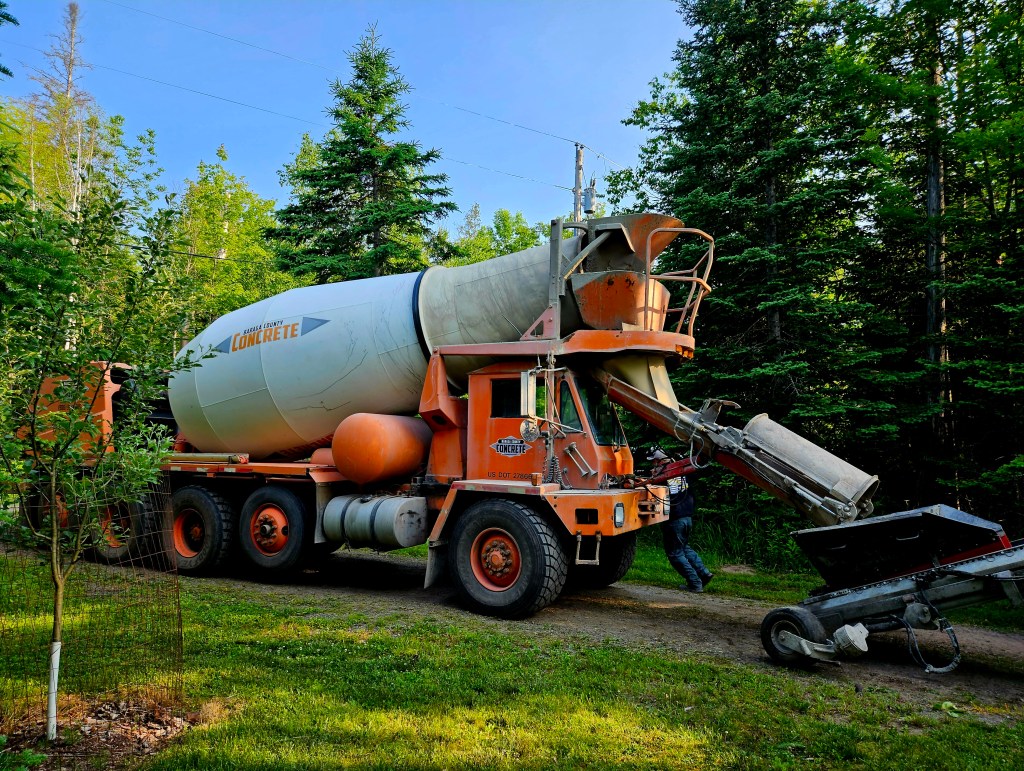
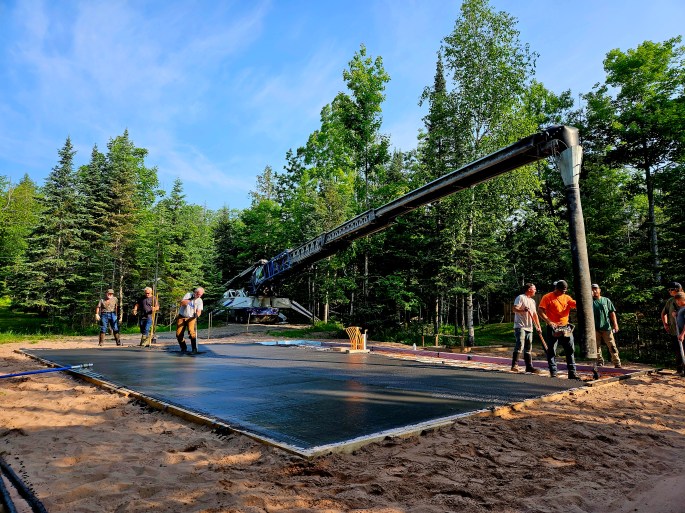
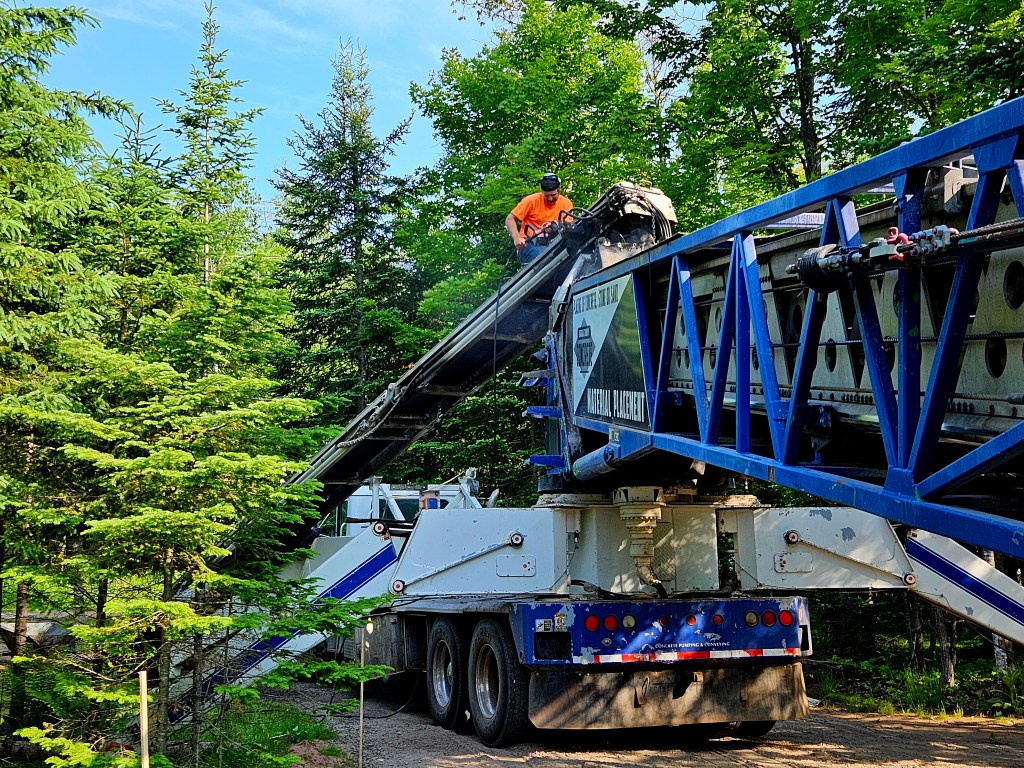
Two trucks delivered our concrete onto a “pump truck” that pumps it onto a conveyor…
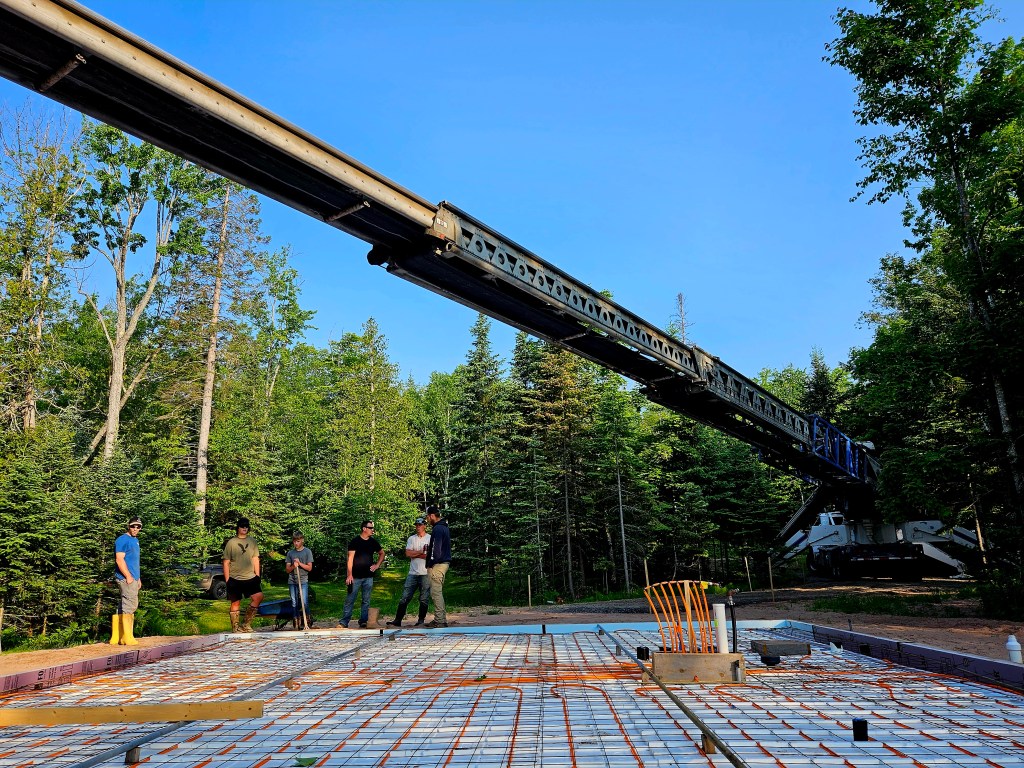
…through a 105-foot boom that carries it to the right spot in the formwork. To think that all that beautiful sand and orange tubes and styrofoam, representing Jeff’s physical and mental labor, will soon be invisible! (The tubes will convey the water that heats the house; see previous post.)
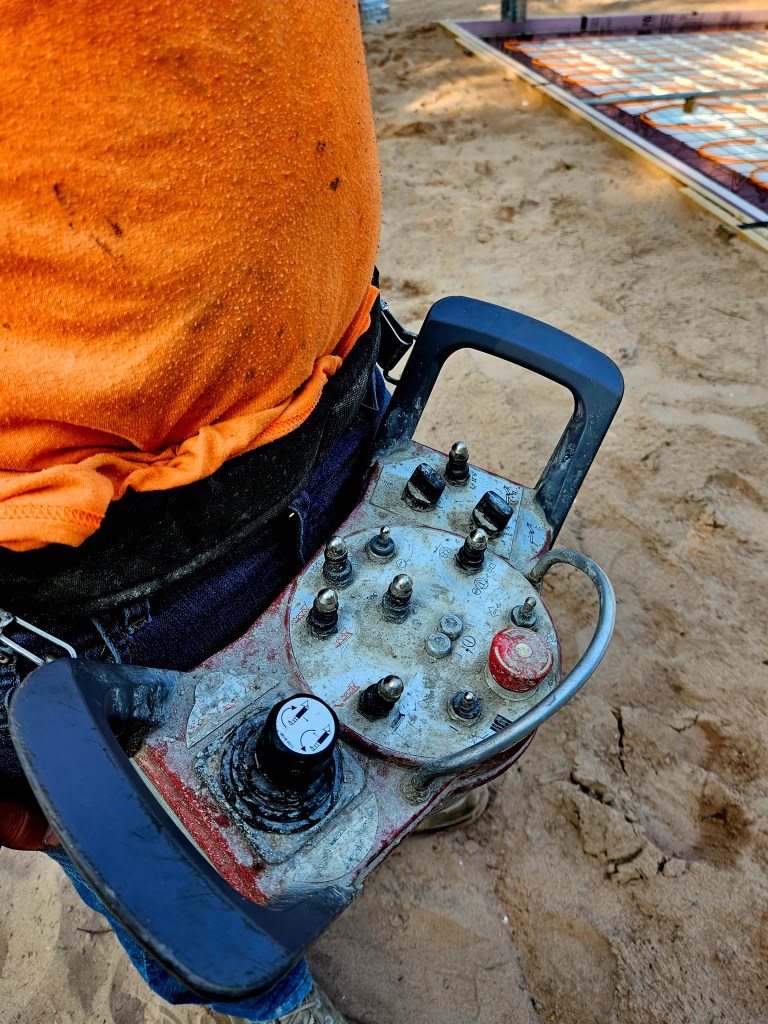
Tucker “drives” the boom/conveyor with remote controls slung around his waist.
These toggles move the boom to drop the cement in the right place.
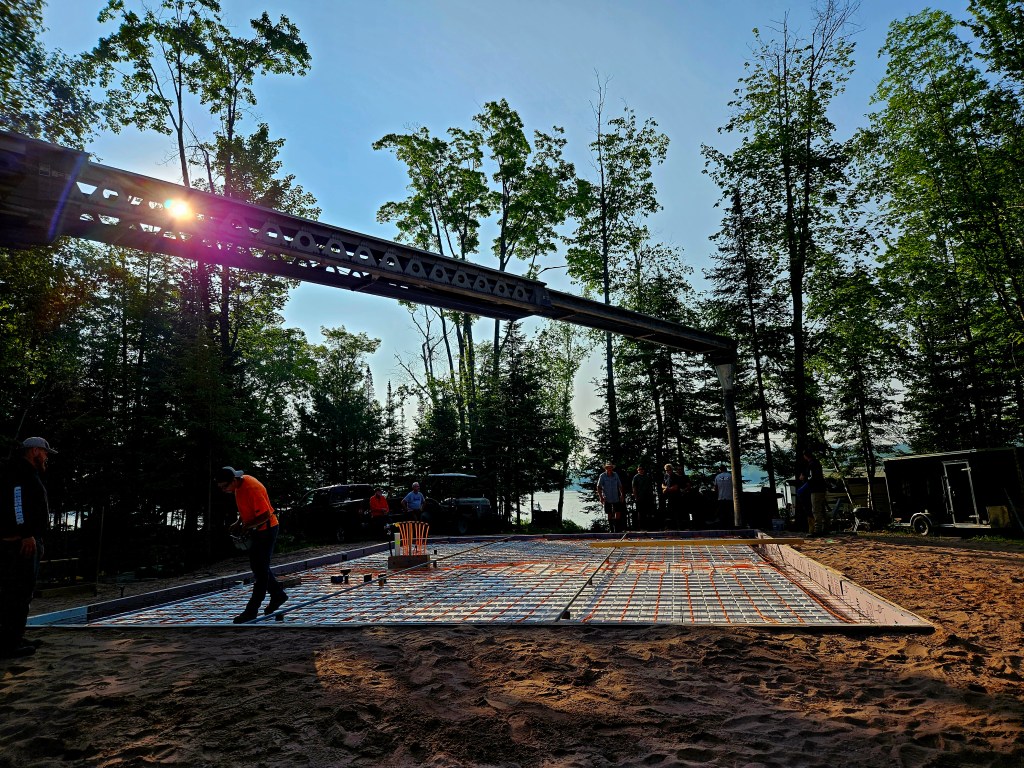
From this angle, you can see the waters of Lake Superior’s Huron Bay to the east as the sun glints off the boom. The house will face the water. Eventually, more trees will come down to open the view — but not too many. I like my trees!
A last-minute consultation….
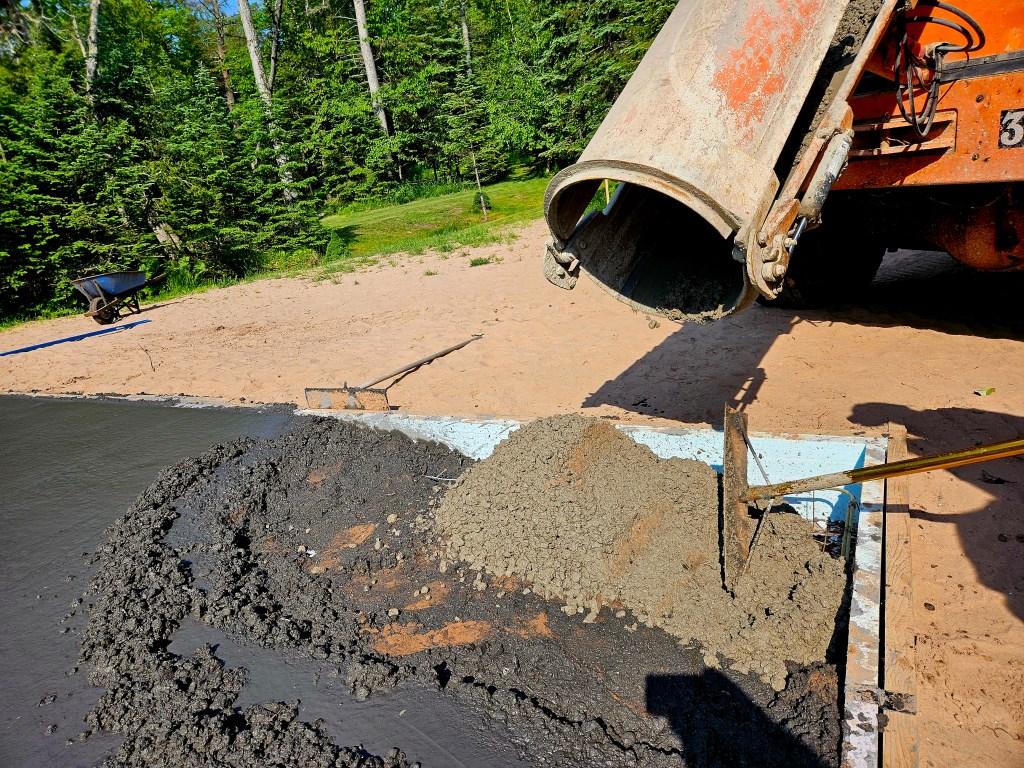
…and “the pour” begins! Out comes black concrete. Yep, black — not gray. I dislike gray and didn’t want it underfoot, so spent $1,000+ to make it black. I would have preferred red(ish), but black was available now and also said to be the most reliable regarding variations. (Apparently, hardly anyone colors the concrete inside their homes — only their patios — so I’m a bit of a pioneer.) I could install a floor covering but that could compromise heating efficiency. Plus, we want the beauty of the stones, currently hidden inside the cement, to shine through; that’s why grinding and polishing comes next.
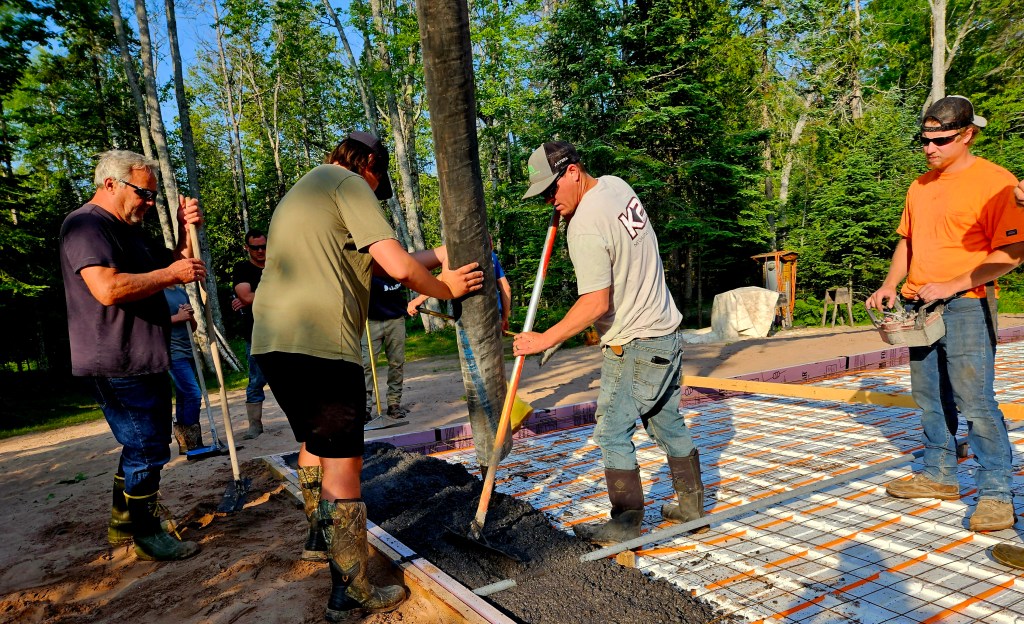
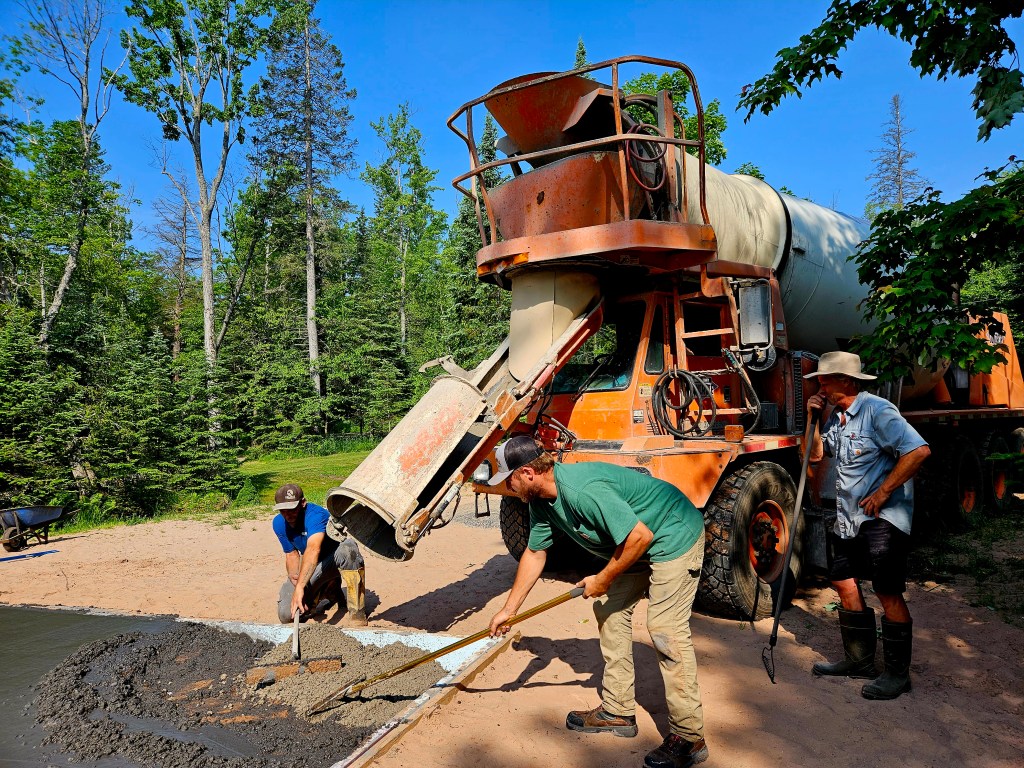
Chase holds the spout to direct the concrete while Jerry starts immediately to spread it as Tucker keeps his fingers on the controls, and Chase’s grandpa Buck (Jeff’s brother) looks on.
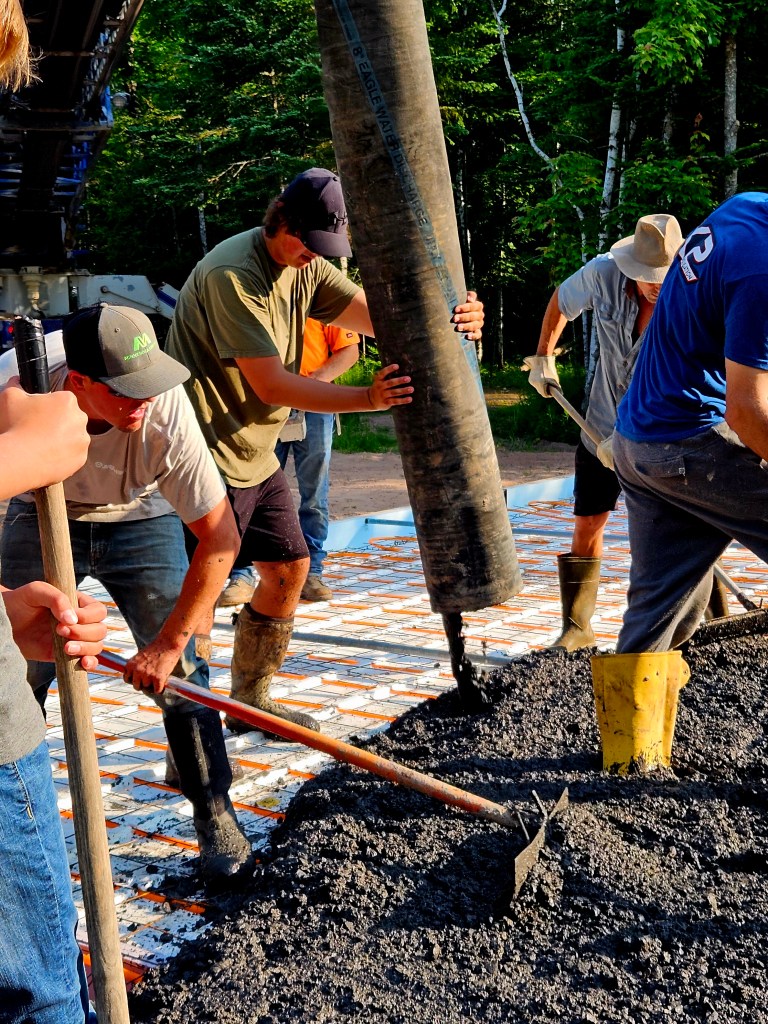
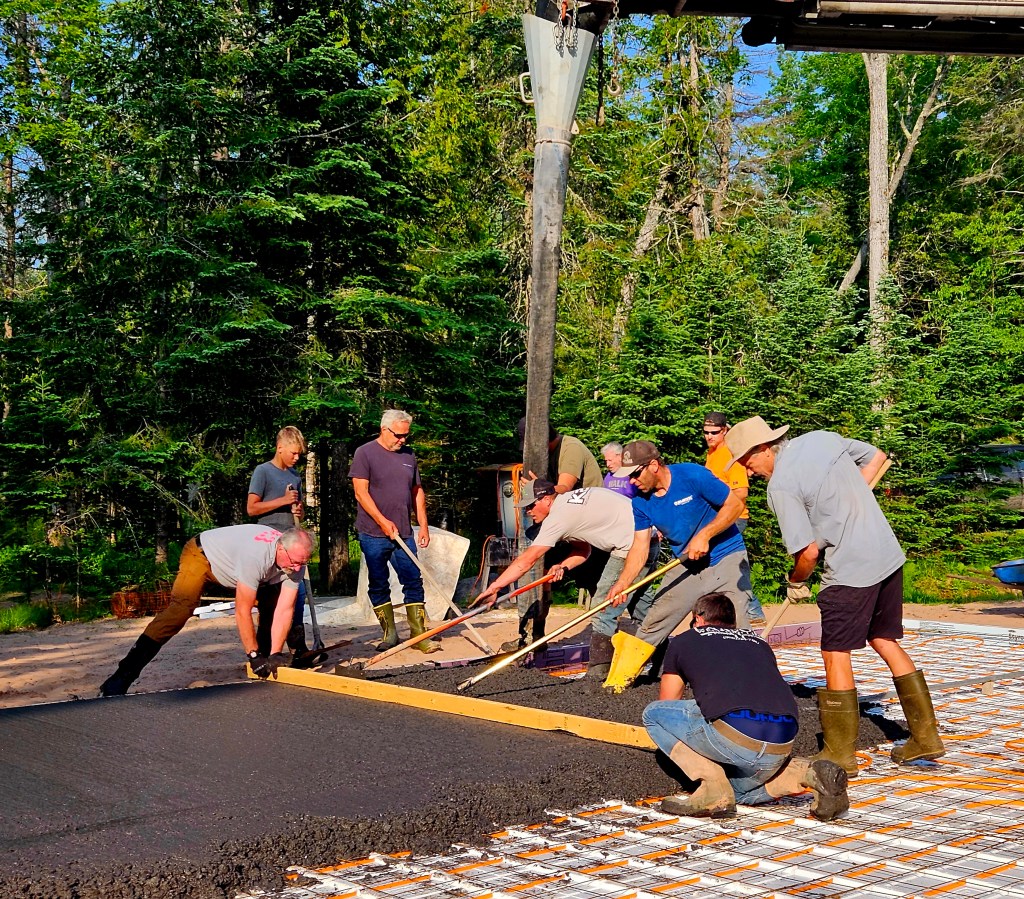
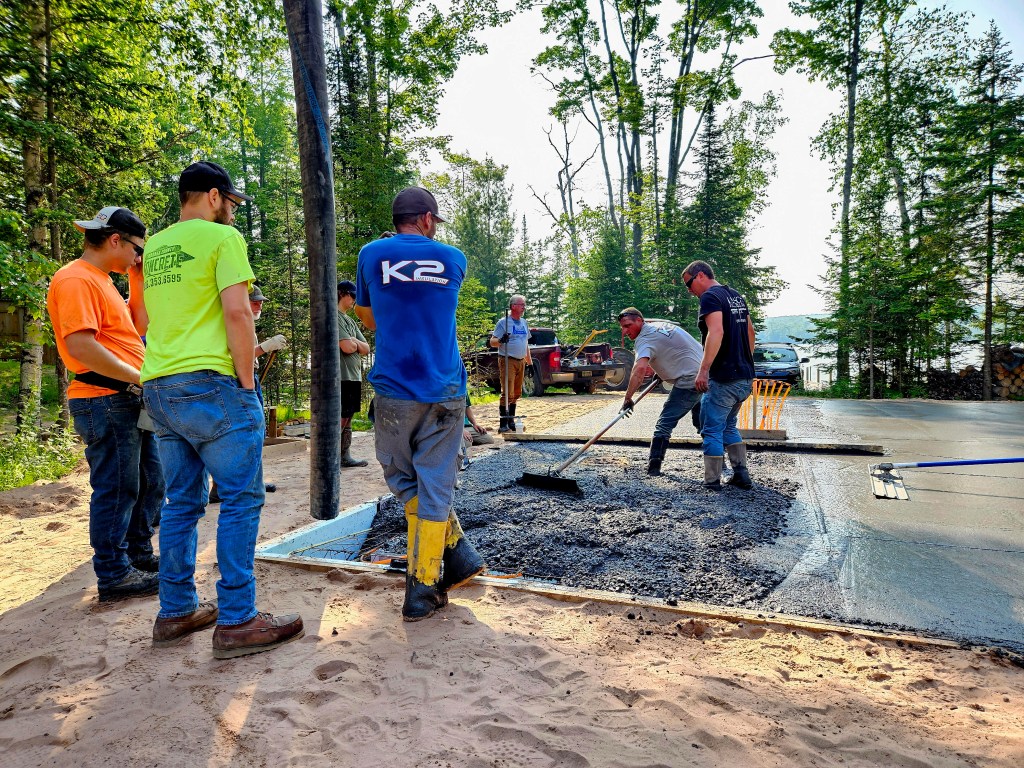
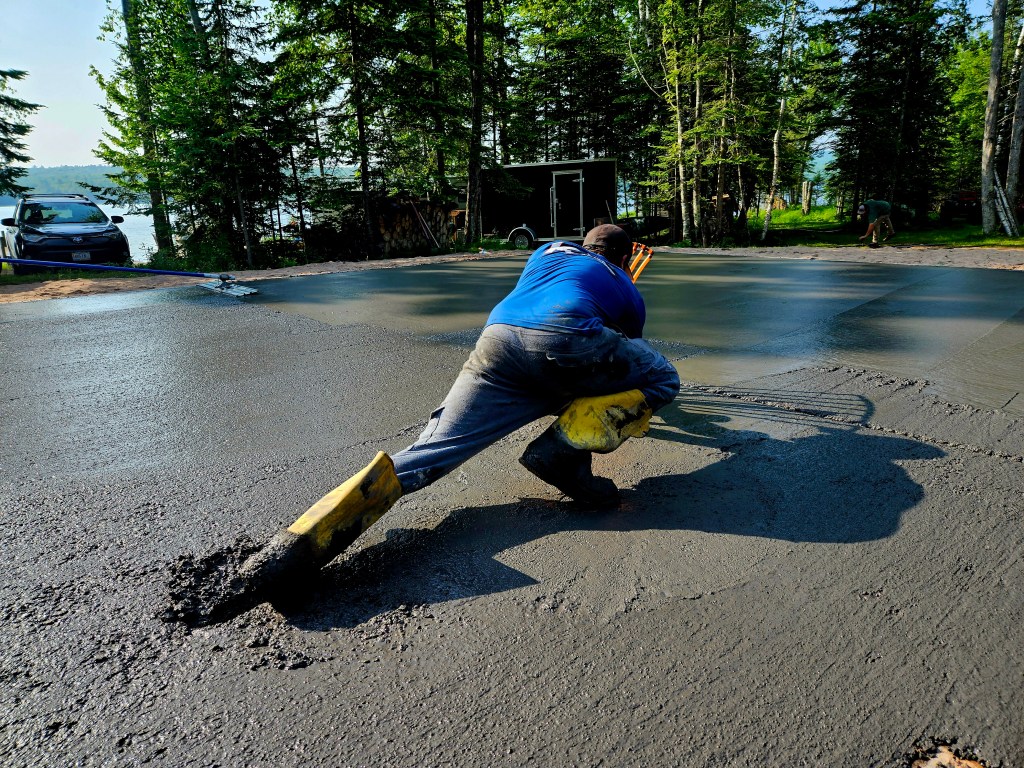
As more concrete comes out, more hands – and feet – get involved. (Notice the yellow boot deep in the concrete; you’ll see it again.) Jeff kept an eye on the slump, which means its consistency before it sets; the higher the slump, the more fluid the concrete. We don’t want it too wet because that makes it harder to grind, and grinding is an essential step in creating a striking floor.
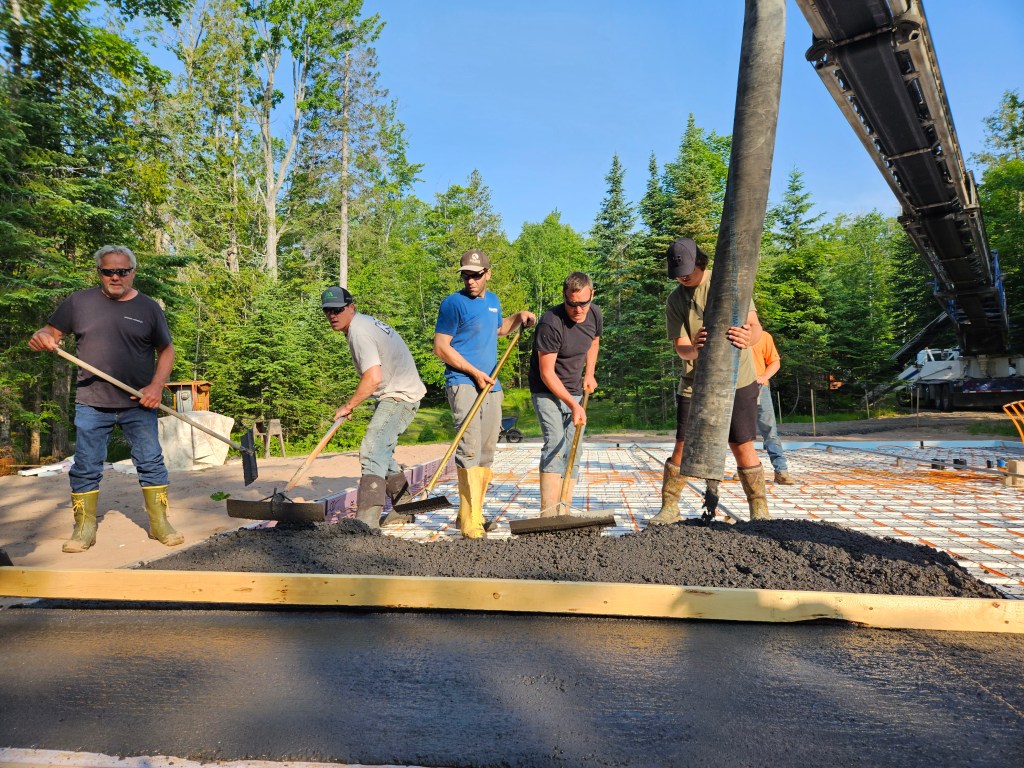
Chase remains on the spout while Buck, Jerry, Shane and Tyler use cement rakes.
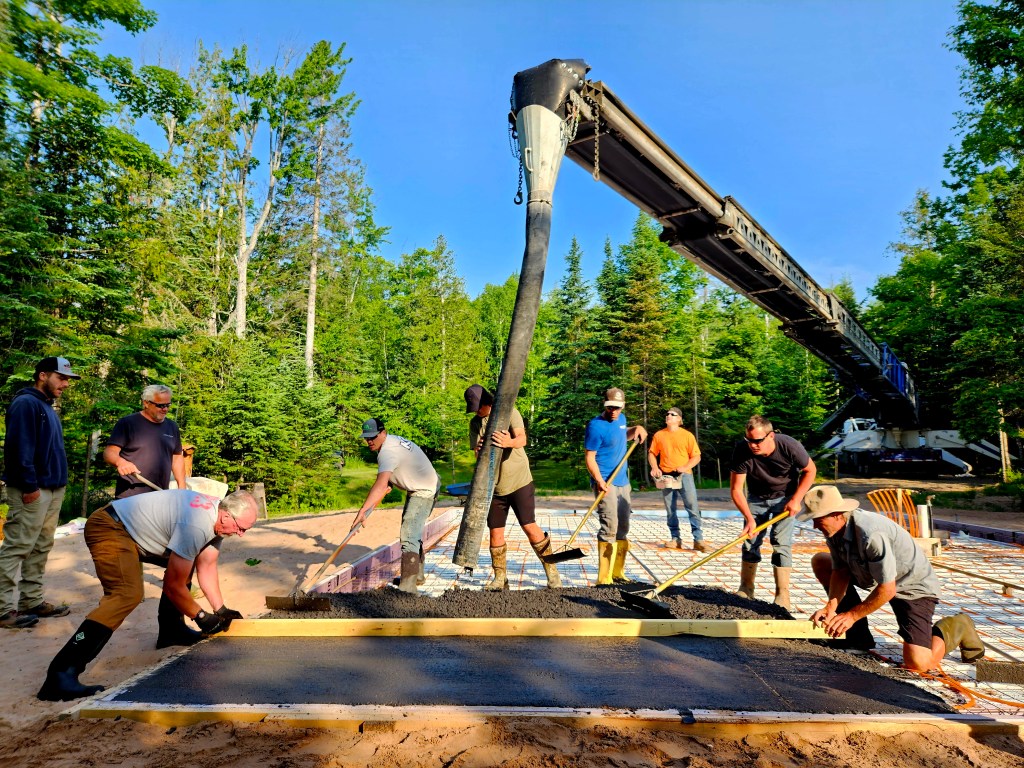
Neighbor John Carroll (also my on-call general contractor) and Jeff pull a board across the concrete to level it as pouring and raking continues farther down. Another neighbor, with no building experience, did fetch-and-run duty and was glad to help out.
Like I said, a dance. Nobody got in anyone’s way. But then, most of them have done this before.
Starting the last “run,” which begins in the northeast corner of the future kitchen.
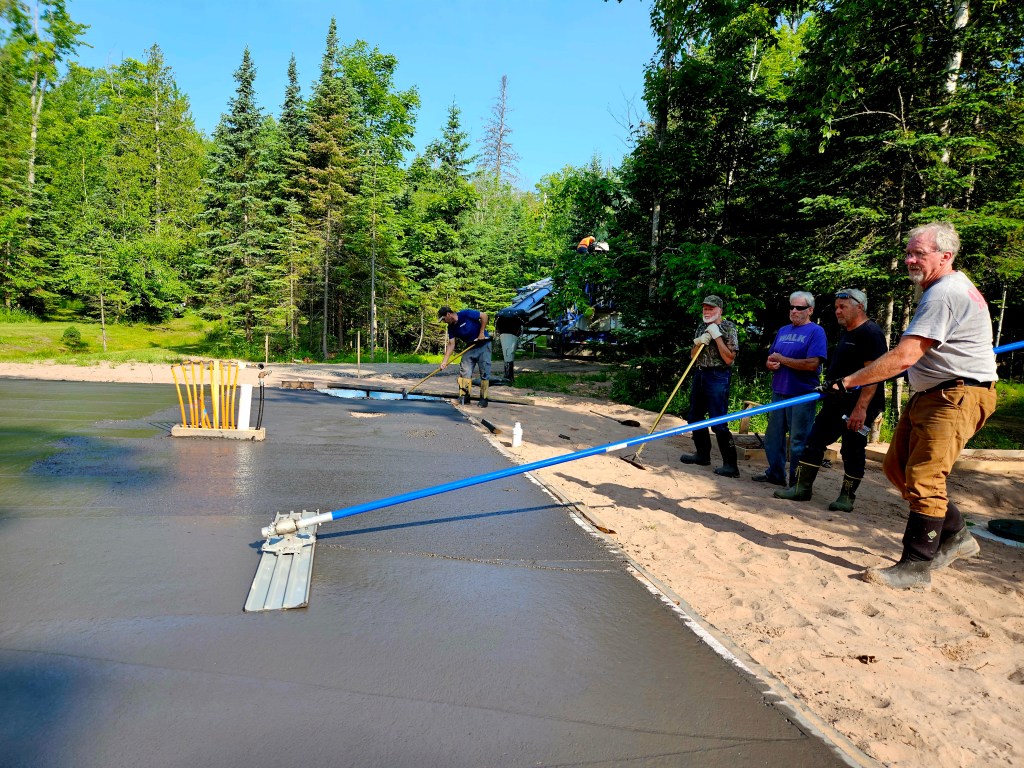
John pulls a float across the (future) kitchen floor to smooth the cement.
As others continued to rake and smooth, Tucker cleaned his boom truck to prepare for the next job. Construction season is short in the north, and the cement business hops in June. (We all hope to be raising walls in July.) As I keep an eye on my watch — because I’m paying an hourly rate for these trucks — I reflect that a foundation is one of the essential and pricier (if less-glamorous) parts of new-home construction. My cosmetic choices add to its price. I not only paid for the cement, dye, truck-time, experts to run this rig, and the color-mixing of the cement but also the cleaning necessary after using color. It’s all good, though. Jeff (and this volunteer crew) is saving me a ton. Still, I do keep track. Or try to.
Nearing the end of the rake-and-smooth, in the future bathroom and closet. By this time, we have all noticed that the cement is running out…
…so, a color switch. Aack! We can’t determine if the miscalculation was ours or the concrete company’s. The company hustled out some standard gray stuff to let us finish. (A pricey correction, since we pay by truck-hour plus there’s some kind of minimum charge.) It was frustrating, but these things happen in construction. We’re grateful it affects just a closet. Note: If I didn’t buy black dye, the entire foundation/floor would be this standard gray. Most who do this leave it gray since the embedded stones add variety after the grinding occurs.
No conveyor needed to deliver this “oops,” just a standard concrete truck. Shane and Dillon spread out the small amount of concrete and the truck left quickly for its next job.
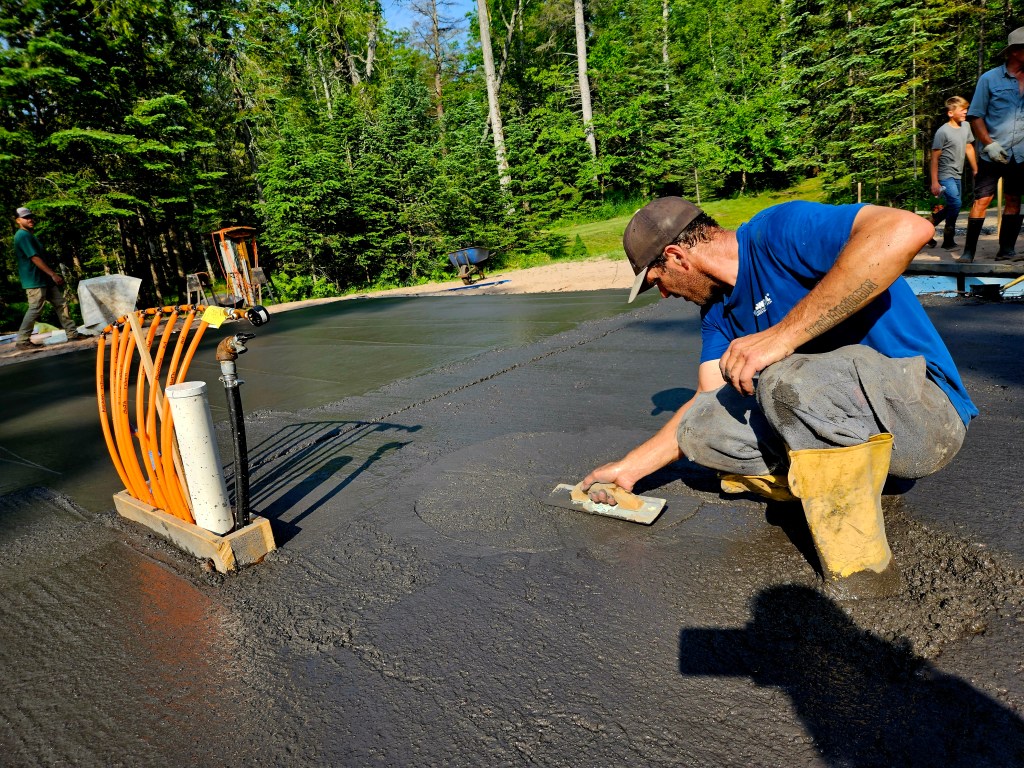
As Shane smooths around the floor drain of the future mechanical room with a hand trowel, he’s immersed in the cement. The right boots are necessary for this job!
Now that’s attention-to-detail.
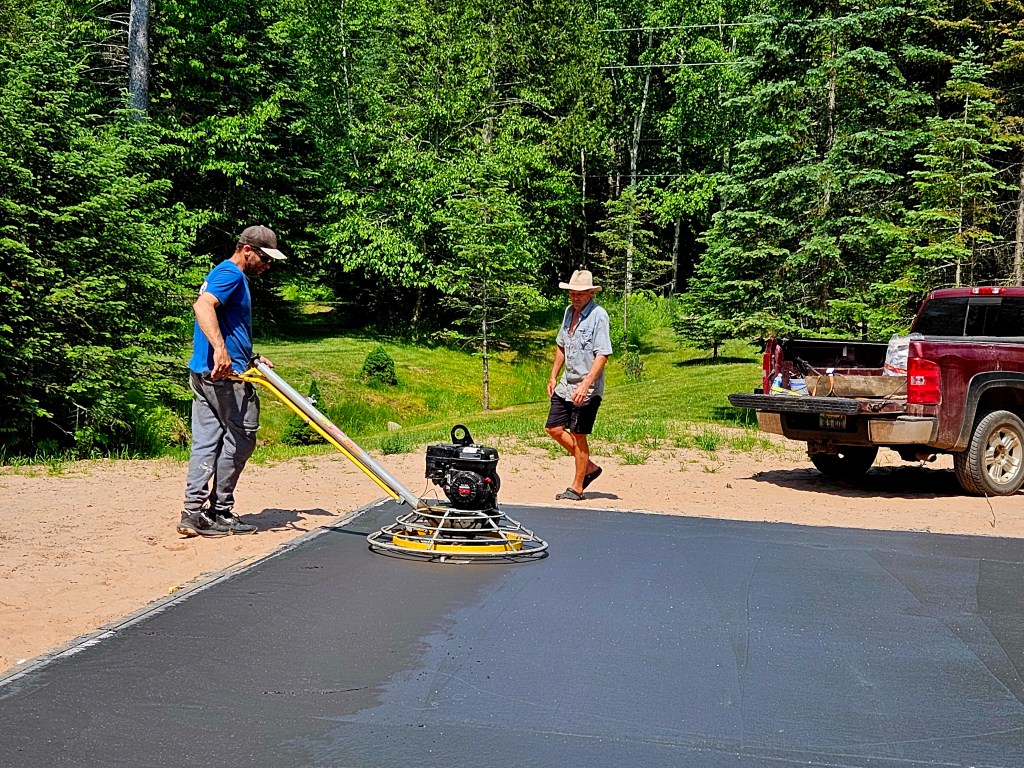
Shane finished the “finishing” with a power trowel, which Jeff rented yesterday. It broke down late in the job, but no real harm done. I guess renting tools carries that kind of risk…
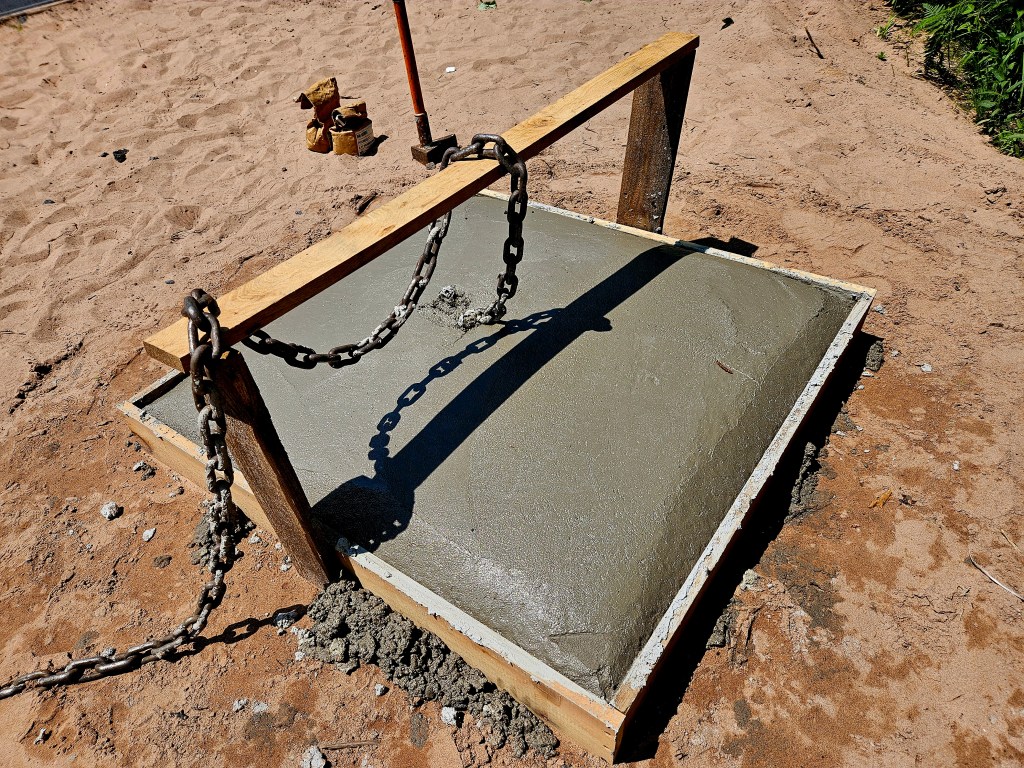
With the extra concrete left over after the “oops,” Jeff made a platform for the 500-gallon propane tank that will sit here, plus…
…this 4×4 platform he hopes to drop to the bottom of Huron Bay, just offshore. He plans to attach a mooring ball to this, which will allow Mainship Many Moons to move with the winds and current – much easier than the complex anchoring system we’ve been using! (The boat remains on land this summer while building proceeds. 😔)
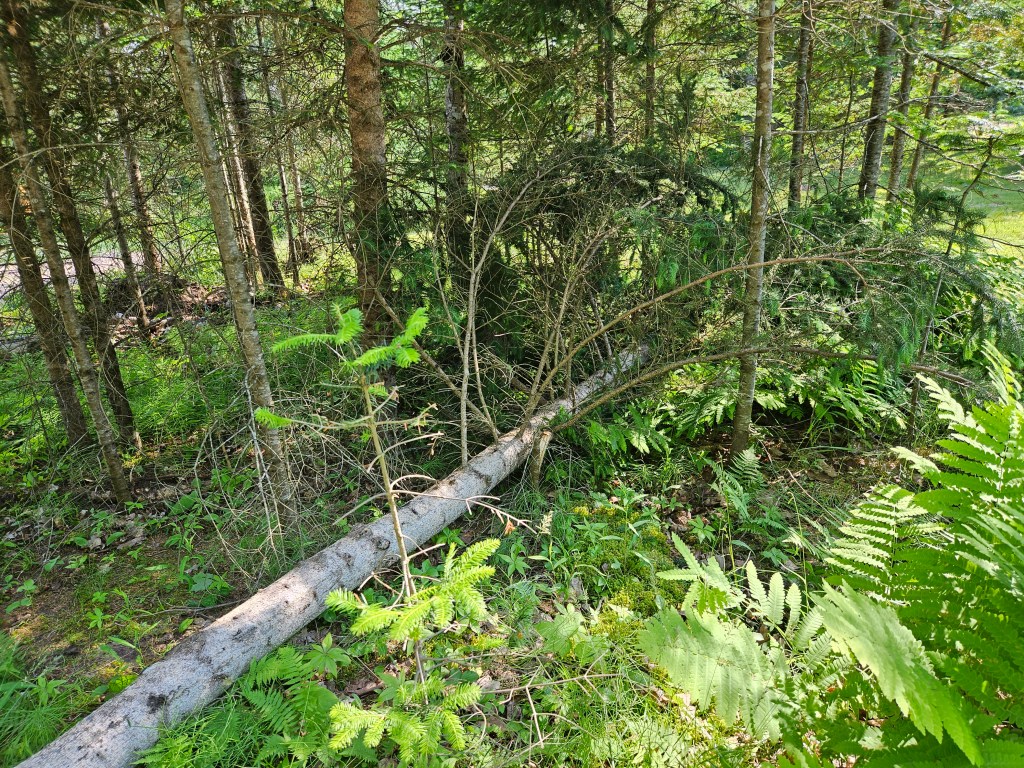
One of two healthy trees to go down under the swing of the huge boom truck. I’ve been warned many times to expect the unexpected during construction. This is one of them.
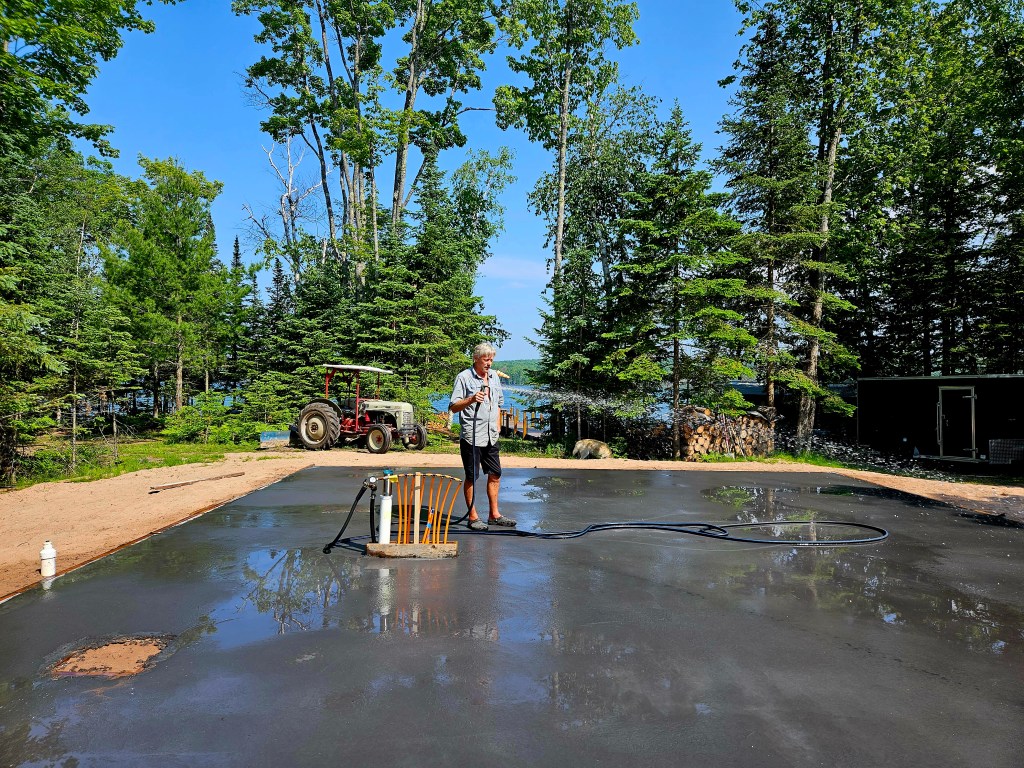
Jeff wets down the concrete, which hardened fully in under six hours, to prevent cracking. You can see his antique tractor from the 40s in the background, still very useful.
He isn’t really giving himself a shower here, though he should be in this heat! (I jumped into the water twice, in my clothes, to cool off.) I’m facing the spray while taking this photo.
Three short videos follow, to give you the visceral experience of “the big pour.” I’m told it isn’t that big, since this is a modest 38×26 house. But it was big to us! Enjoy…
I loved seeing the process of building a heated floor and foundation; the layers of detail from start to finish. But the videos of the “big pour” showed how everything had to come together so quickly with everyone in place with a job to do. What a wonderful fete of coordination and cooperation.
Yep, I did. And consulted an expert on that. Staining after the fact is more common than adding color before the pour. But I want to see our local rocks, which are quite special, show through. That’s why we chose grinding and polishing instead. (Along with coloring the concrete first, most don’t do.) It is rather an experiment! Part of the excitement. And risk.






 For Many Moons
Thanks for sharing your building of your beautiful home to be! Great seeing Jeff again, too.
LikeLiked by 1 person
Good to hear from you! Hope you are well…
LikeLiked by 1 person
Great update , pics and videos. A community event like an old barn raising by the Amish.
LikeLike
I loved seeing the process of building a heated floor and foundation; the layers of detail from start to finish. But the videos of the “big pour” showed how everything had to come together so quickly with everyone in place with a job to do. What a wonderful fete of coordination and cooperation.
LikeLike
People frequently stain gray concrete did you consider that?
LikeLike
Yep, I did. And consulted an expert on that. Staining after the fact is more common than adding color before the pour. But I want to see our local rocks, which are quite special, show through. That’s why we chose grinding and polishing instead. (Along with coloring the concrete first, most don’t do.) It is rather an experiment! Part of the excitement. And risk.
LikeLike