What happens when you reach the end of the earth? Do you fall off?
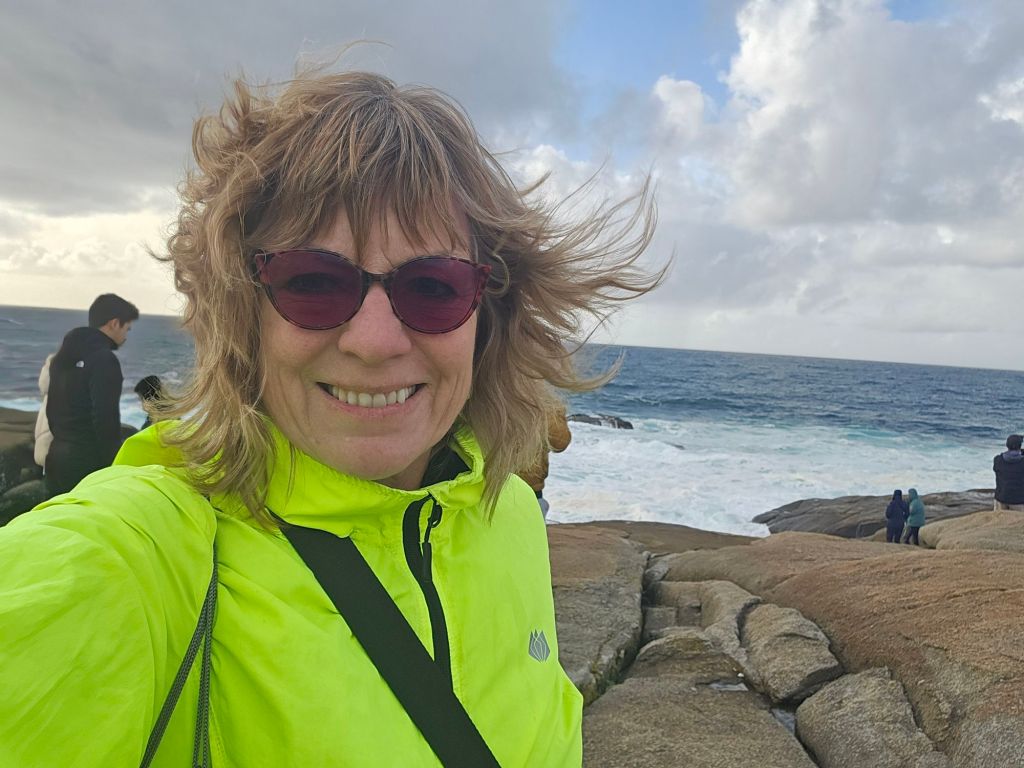
Back in the day when people thought the world was flat, they must have wondered. Us? We stood on the rocks and felt the wind whip our hair.
The day after arriving on foot in Santiago de Compostela (after walking 80 miles), Ginny and I took a bus to Finisterre — aka “the end of the earth.” It isn’t the westernmost point of Europe, or even Spain. But it does feel like it! Many pilgrims add on this 56-mile extension after finishing their route to Santiago. We did it by bus, but I’d like to walk it some day. (That happens to many after their first walk on El Camino. You get the bug and want to do more. It’s hard to explain.)
Consider how many other places call themselves “the end of the earth.” France has one. So does Argentina. The northernmost tip of Norway feels like it. My sister Barb lives near one, on the northwest tip of the U.S. Nonetheless, this was a special trip. Photos and captions follow.
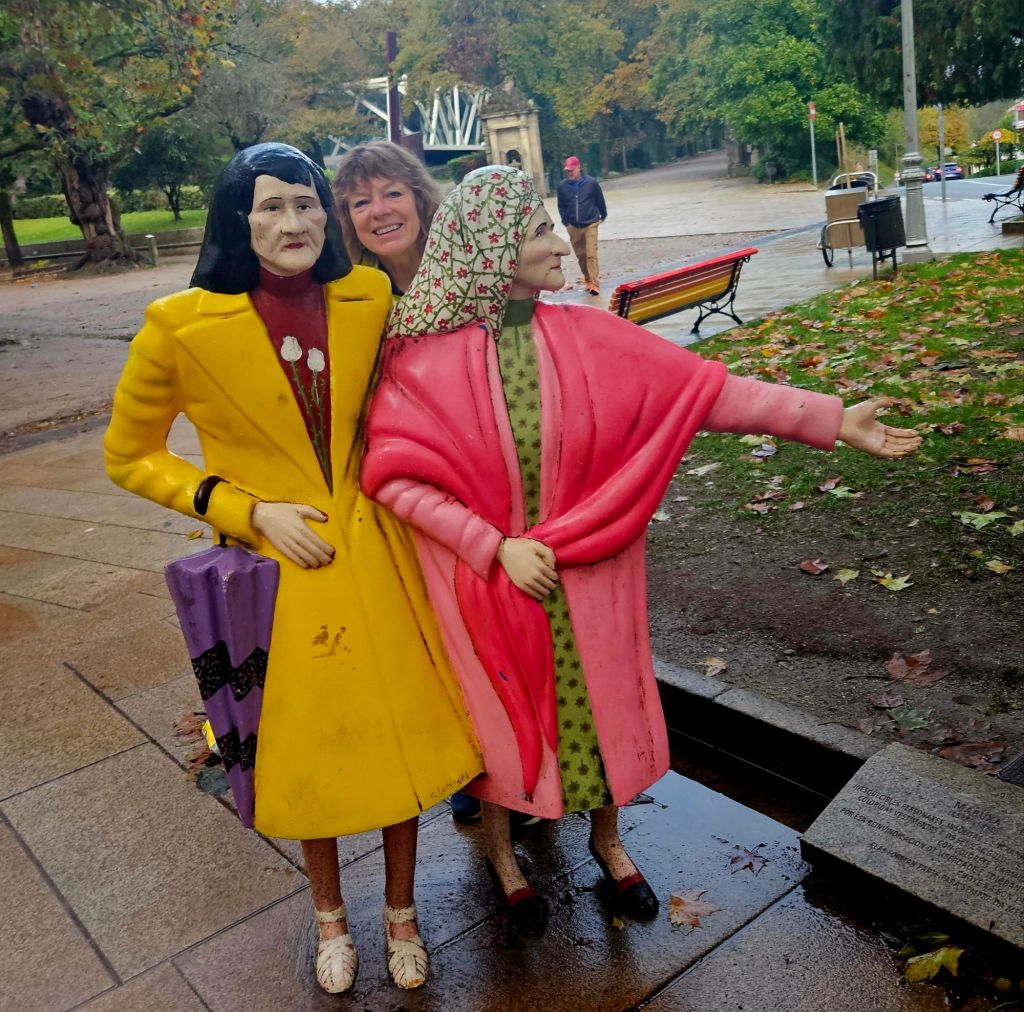
Walking to the bus pick-up point in downtown Santiago de Compostela, we came across this sculpture. The woman on the right reminds me of Mom. She liked patterns, and also wore a scarf that way (but not low on the forehead). Finnish women call it a huivi.
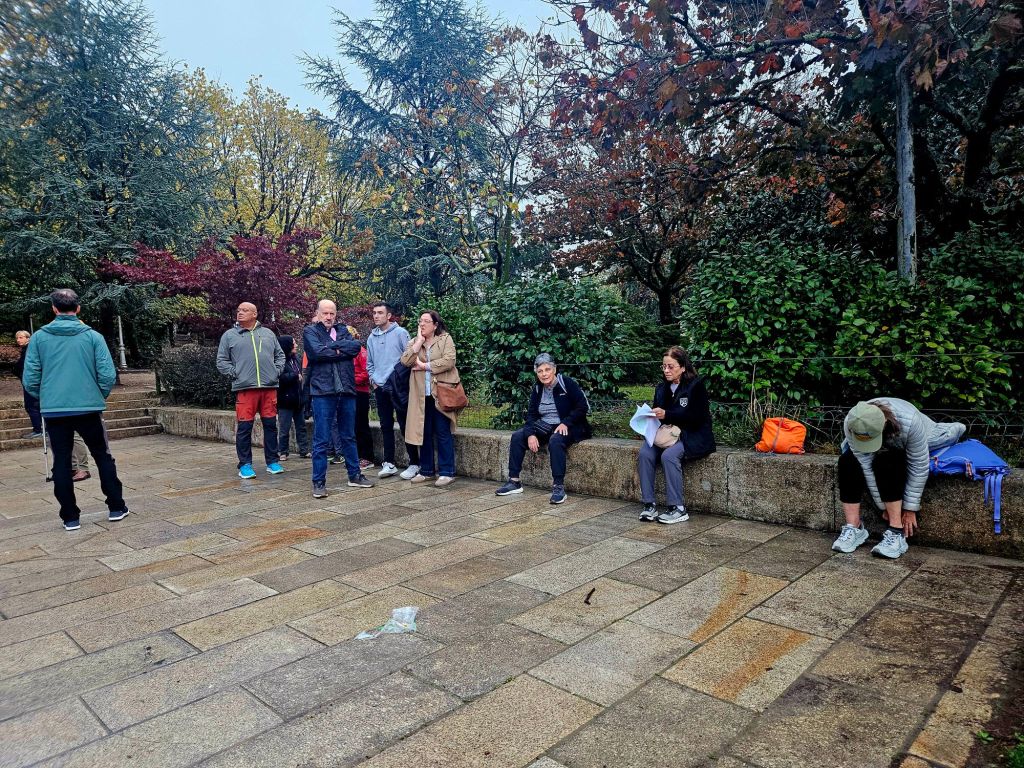
We joined others waiting for bus tours as Ginny sorted out her footwear.
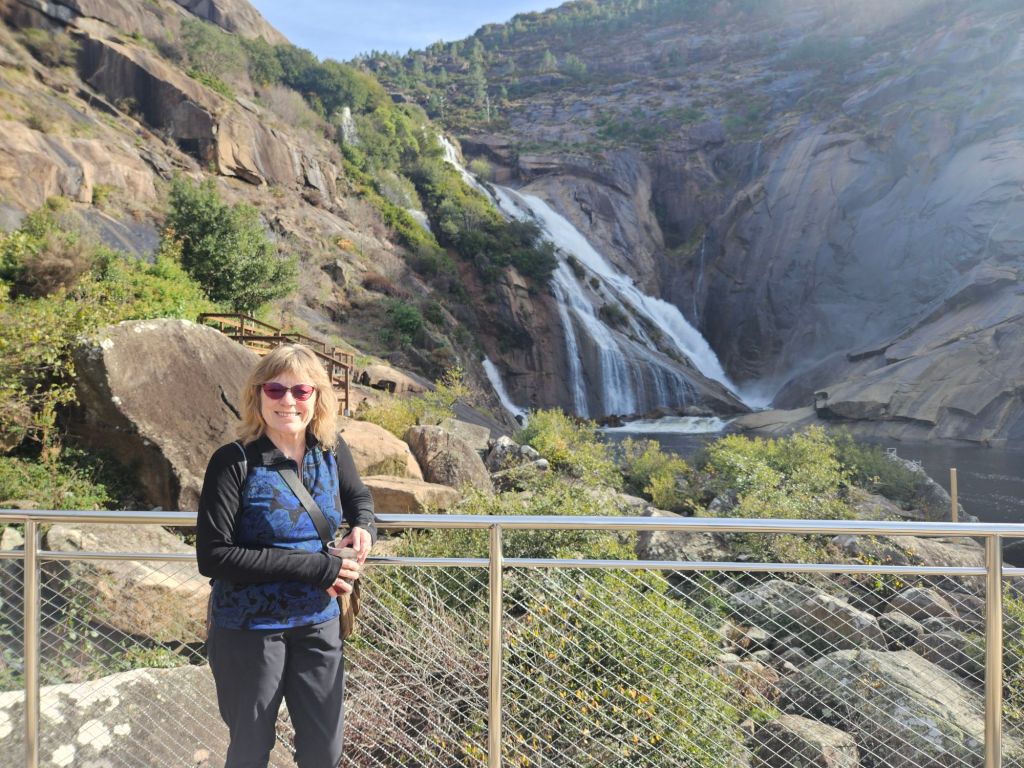
Along the way, we stopped at a waterfall…
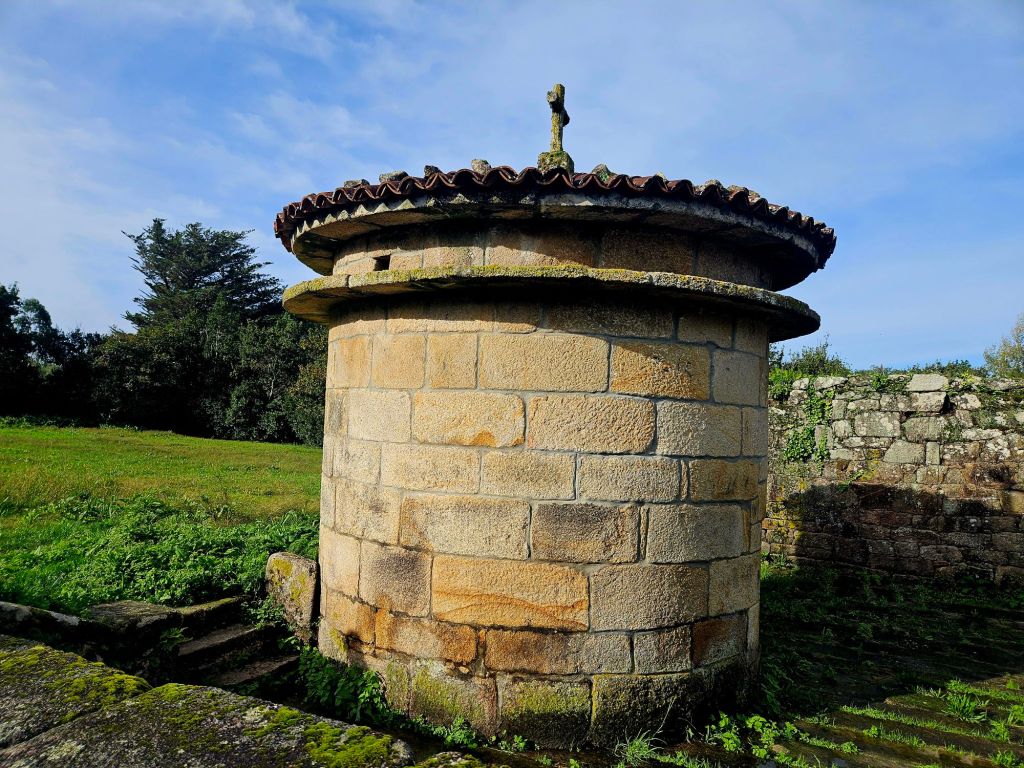
…and the largest hooreo (grain storage, common in northwestern Spain) we’ve seen so far…
…and this “pigeon trap” which entices pigeons inside so they can be eaten. Did you groan? It’s a bird! We eat birds in the U.S., too, but we call them fowl–meaning, birds hunted for sport or food or raised for meat or eggs. I wonder why we don’t eat pigeons? That urban image, I guess…dirty and noisy. I like pigeons! Doves are pigeons! But I don’t want to eat one either.
Yet another picturesque Catholic church with citrus trees nearby. Catholicism has dominated Spain’s history and remains a prominent influence.
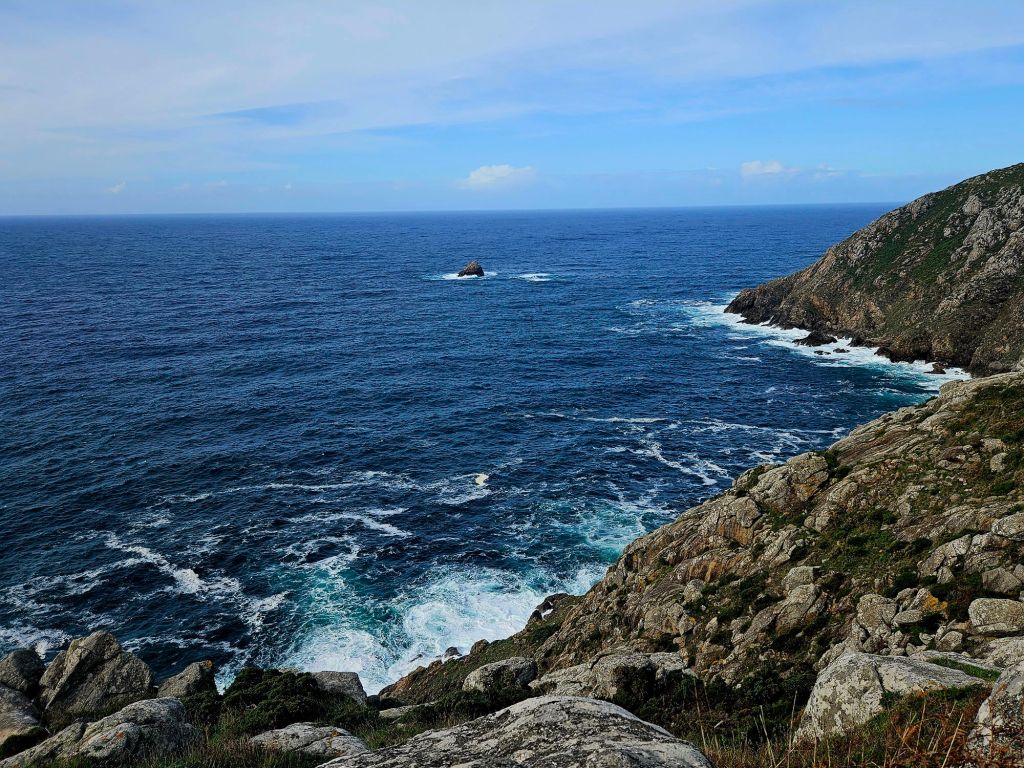
And then we reached it. The Atlantic Ocean. I’m used to seeing it from the western side. I’ve seen it from this side, too, on the beaches of Normandy in France. (I was fortunate to be sent there by the Navy for the 50th anniversary of D-Day.) But this is different. Wild.
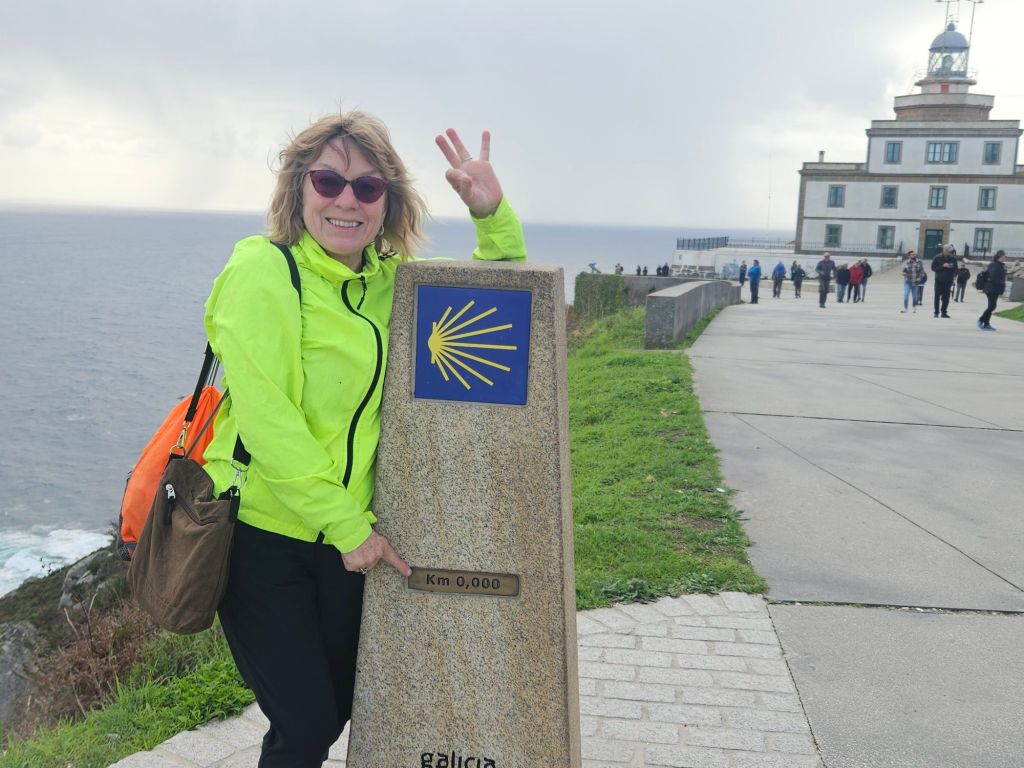
It’s also “Kilometer 0” of El Camino, even though it’s just an extension. (Santiago de Compostela is “the” destination. Because of that cathedral discussed in the last post.) When the earliest pilgrims walked this way, this was the spot where they supposedly picked up the scalloped shell representing the end of their journey. ( The same shell you see on this marker and on our backpacks.)
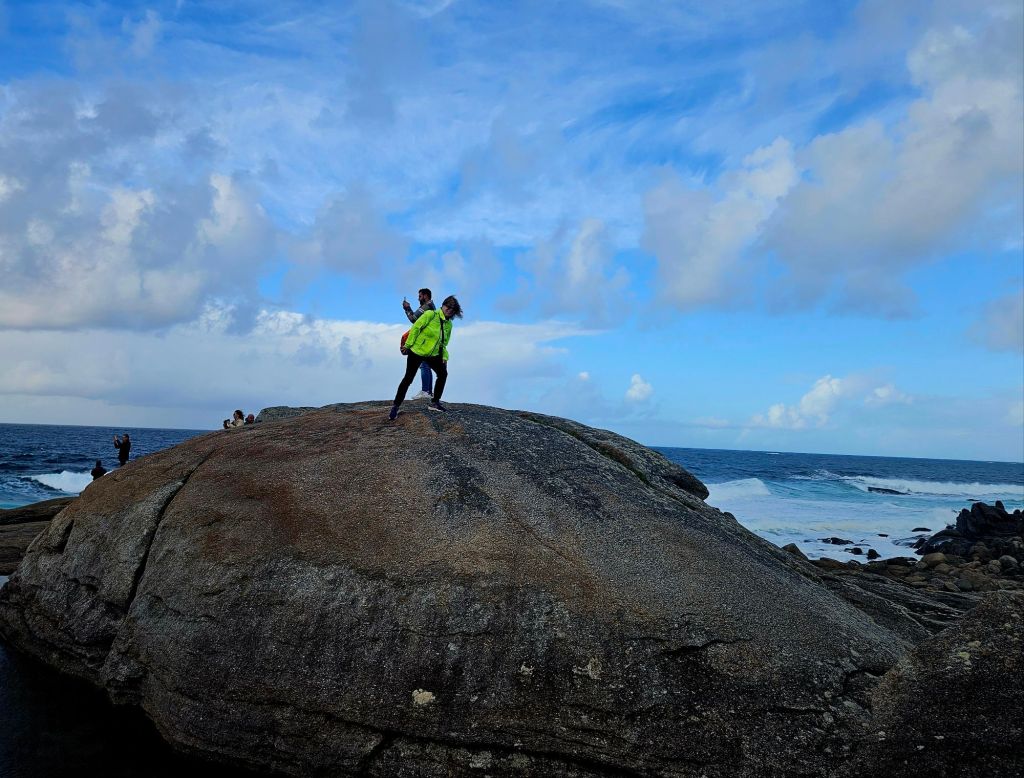
I could spend a day sitting on these large flat rocks and reflecting on human nature and beliefs. For example, despite overwhelming scientific evidence, a small but visible movement still believes in a flat Earth, propelled partly by the internet. The good and the bad of technology! (We forget that the invention of the printing press caused huge disruption also.)
Yeah. That’s where I would plant my chair for the day. Unless it blew away.
The wind was brisk!
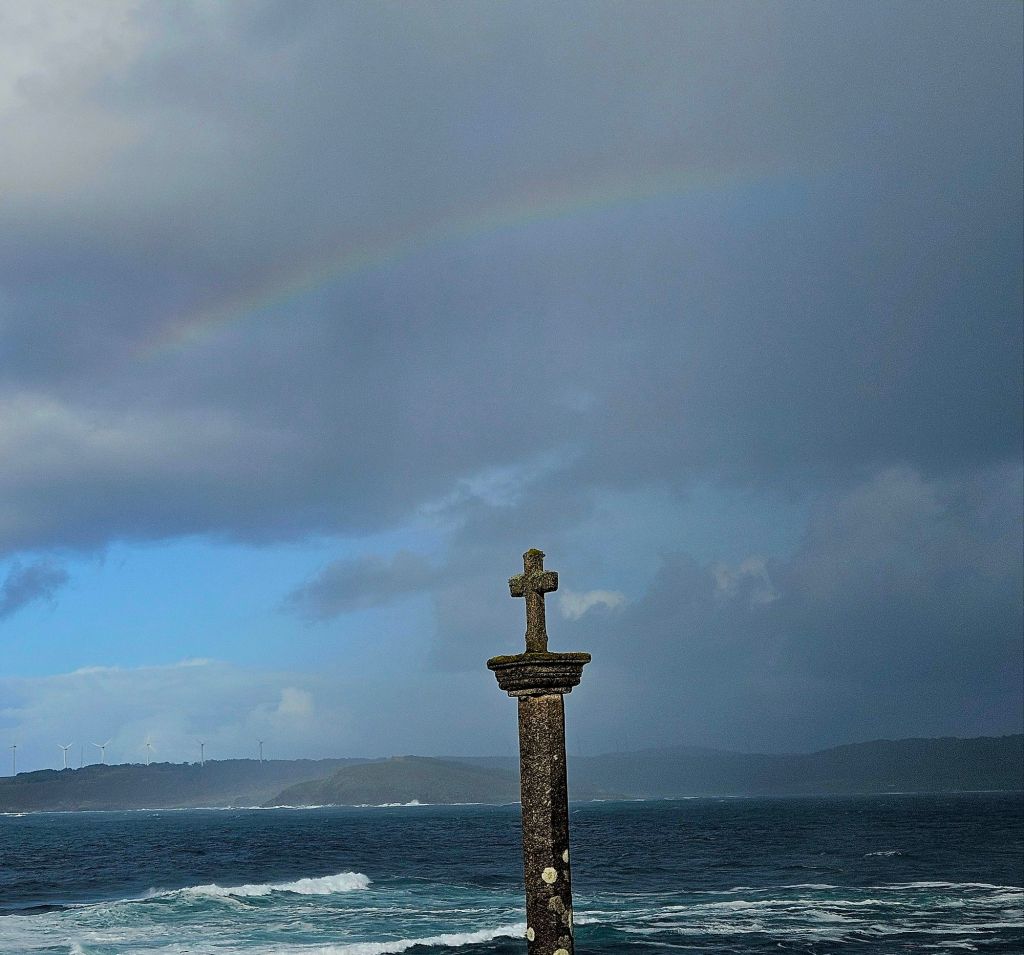
How fortunate to catch this brief rainbow above a waterfront cross.
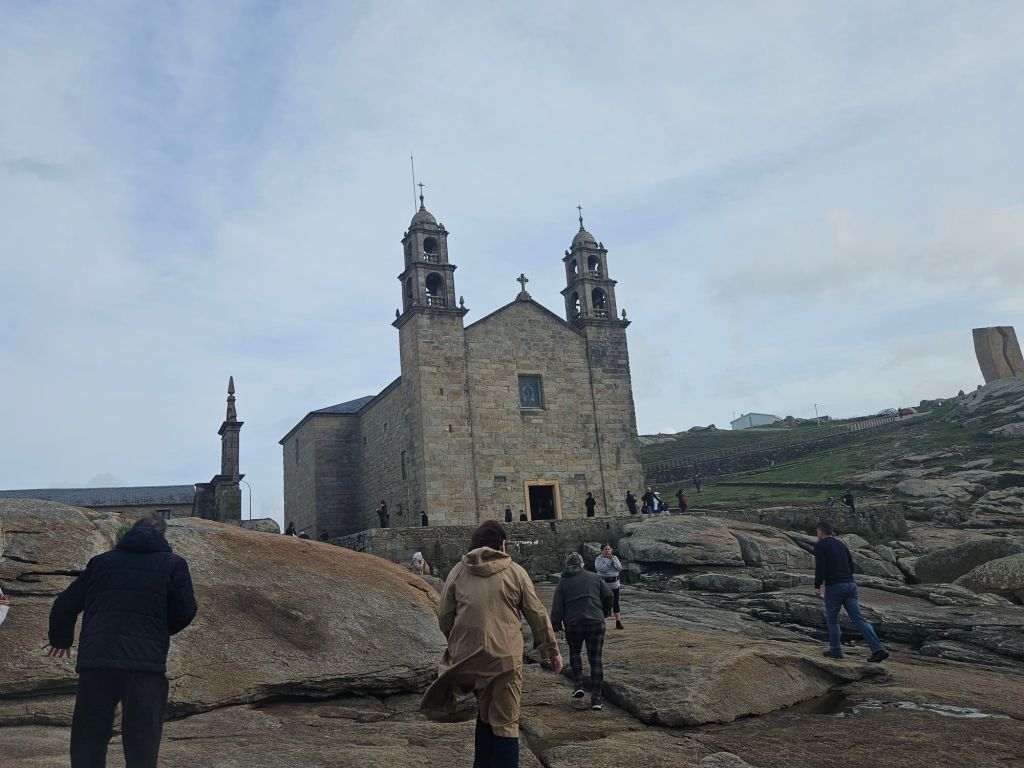
And then, this church on the bluffs. The sound of chanting beckoned us inside.
It’s dedicated to mariners. Well, of course. We were on the ocean. As a Navy officer, I felt welcomed here. Thinking of Christopher Columbus, the Italian who was funded by Spain and sailed from this coast across the ocean in 1492 and is credited with “discovering America.” He was looking for a sea route to Asia and landed in the Caribbean, then explored Central and South America. He never landed in North America, as far as we know. Yet how many of us grew up imagining him planting a flag somewhere in the U.S? C’mon, I know I’m not the only one. 😉
I jumped on this trip after my oldest sister had already planned it. I will be grateful to her forever for letting me do that. Our first time traveling together, and we have learned new things about each other. Traveling together does that!
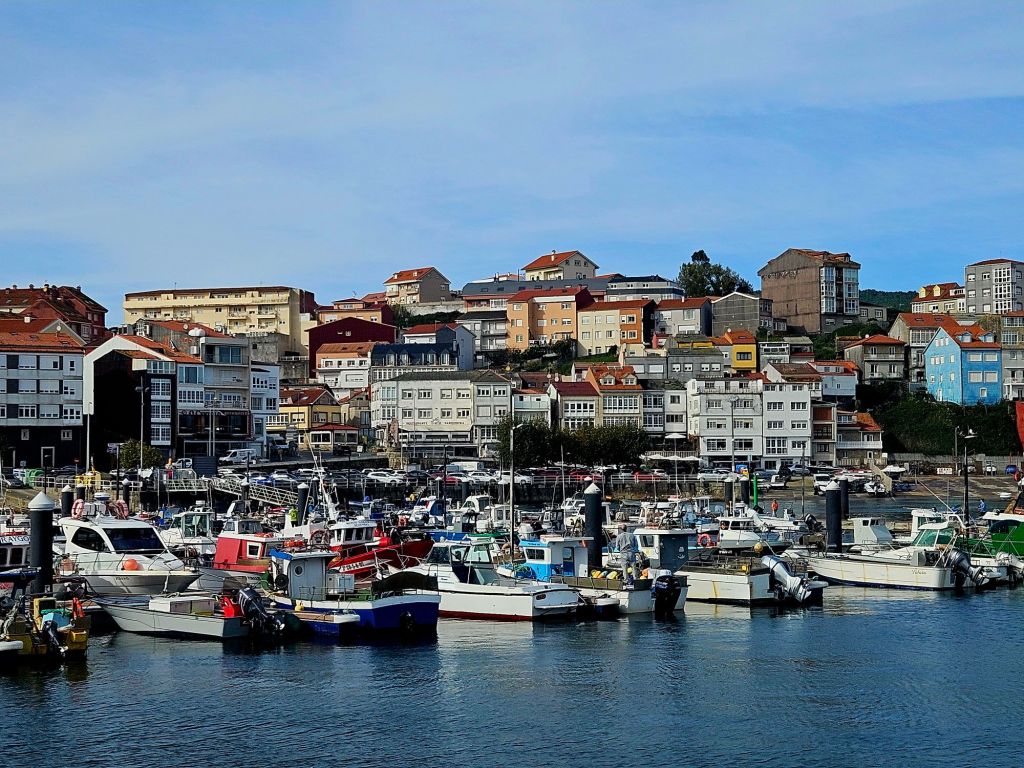
On the way back to Santiago de Compostela, we stopped in this seaside town for lunch.
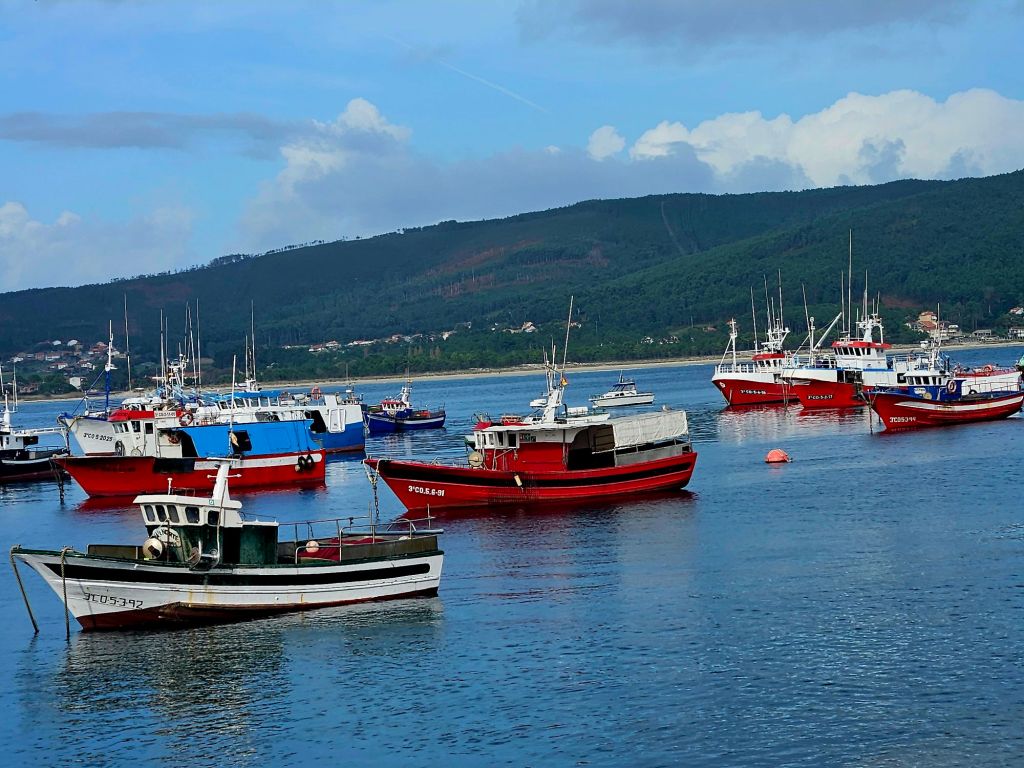
I always linger at harbors, remembering my 5,000-mile boat trip called The Great Loop. We stayed in about 140 marinas. (To read about that trip, click here and keep clicking “next post.”)
The first time I’ve eaten scorpion fish. I’ve seen them underwater while diving, and they’re a bit scary with all those spines. But, delicious!
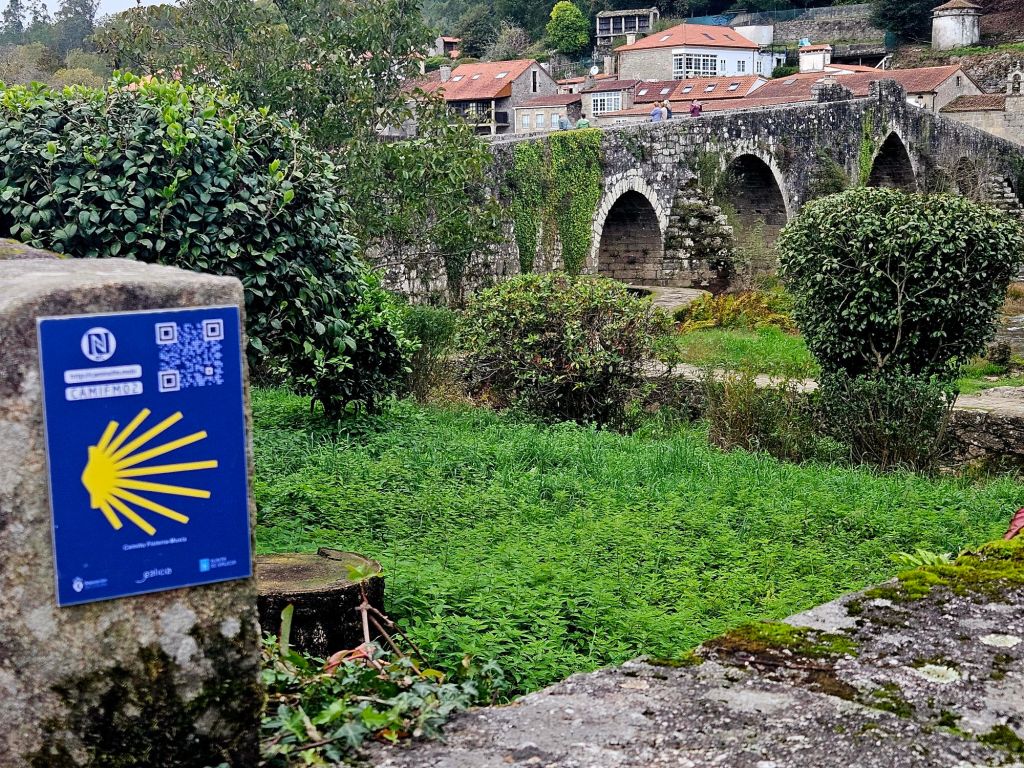
We also stopped in the small town of Ponte Maceira. The El Camino extension passes through here, as you can tell by the yellow shell.
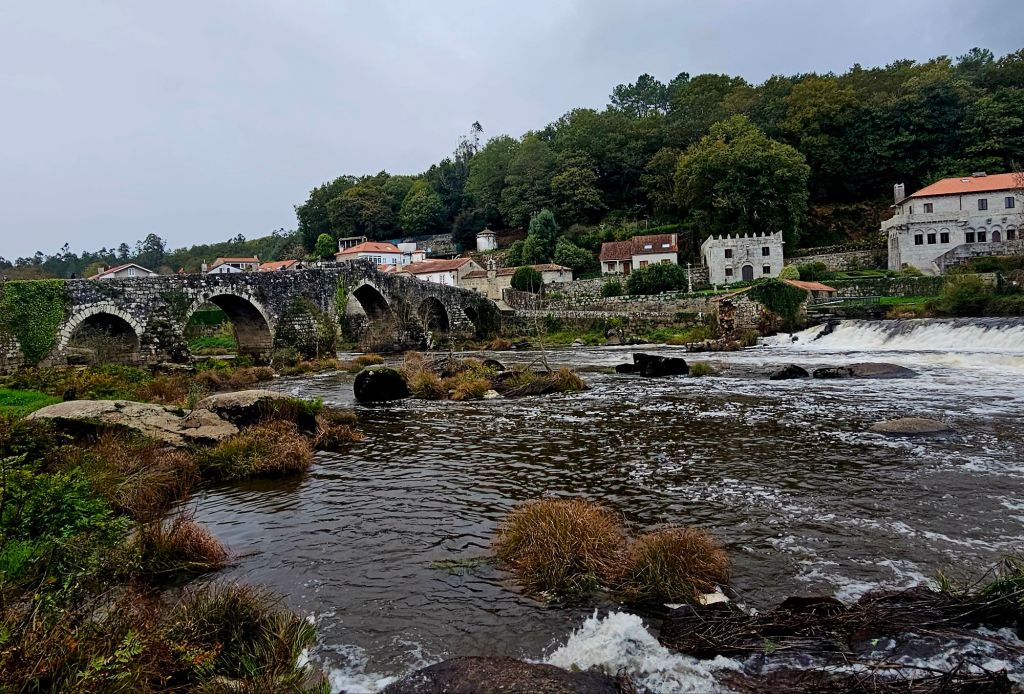
This medieval bridge over the River Tambre incorporates original Roman pillars.
This scene reminded me of Harper’s Ferry in West Virginia, just 90 minutes from my Virginia home….I suppose because the Shenandoah River is filled with lots of rocks, too, and the town is on the water’s edge.
One more look at that picturesque bridge. Because, well, it’s so picturesque! (I only wish someone would trim that bush that’s in the way. 😄)
So proud of Ginny, who is almost 80 and just walked 80 miles in 8 days. Poetic! She introduced me to backpacking in the 70s, when we carried at least 50 pounds on our back and took on rugged Isle Royal. I’m not surprised she managed this. Of course, she wants to do more.
Our bus ride to the end of the earth punctuated the end of our Spain adventure. We had two nights in Madrid coming up, but it’s a city, and we find those everywhere. The “end of the earth?” Not everywhere. Not only here, but also not everywhere. The best thing about traveling is that you see things you don’t see elsewhere — which brings thoughts that you don’t have elsewhere. That’s why I resolve to keep doing it as long as my body holds out. Buen Camino!









 For Many Moons